For a mini gastric bypass you do not need to look far from Spijkenisse: the pathway starts with your own GP, who refers you to a DATO-registered bariatric centre. For residents of Spijkenisse the options include Maasstad Ziekenhuis in Rotterdam (about 15 km) and Franciscus Gasthuis & Vlietland in Rotterdam/Schiedam (about 10 km). Cover runs via basic insurance; with an indication it stays at €385 deductible in 2026. Further down you will find local figures, nearby centres and what the procedure involves.
Mini gastric bypass in Spijkenisse at a glance
- Nearest centre: Spijkenisse the options include Maasstad Ziekenhuis in Rotterdam (about 15 km).
- A BMI from 40 upwards can make you eligible, as can a BMI from 35 upwards combined with a condition like high blood pressure, type 2 diabetes or sleep apnoea.
- With an indication and a GP referral you only pay your €385 deductible (eigen risico, 2026).
- Expect 60-90 minutes on the operating table. The average loss is 30-40 percent of your total weight.
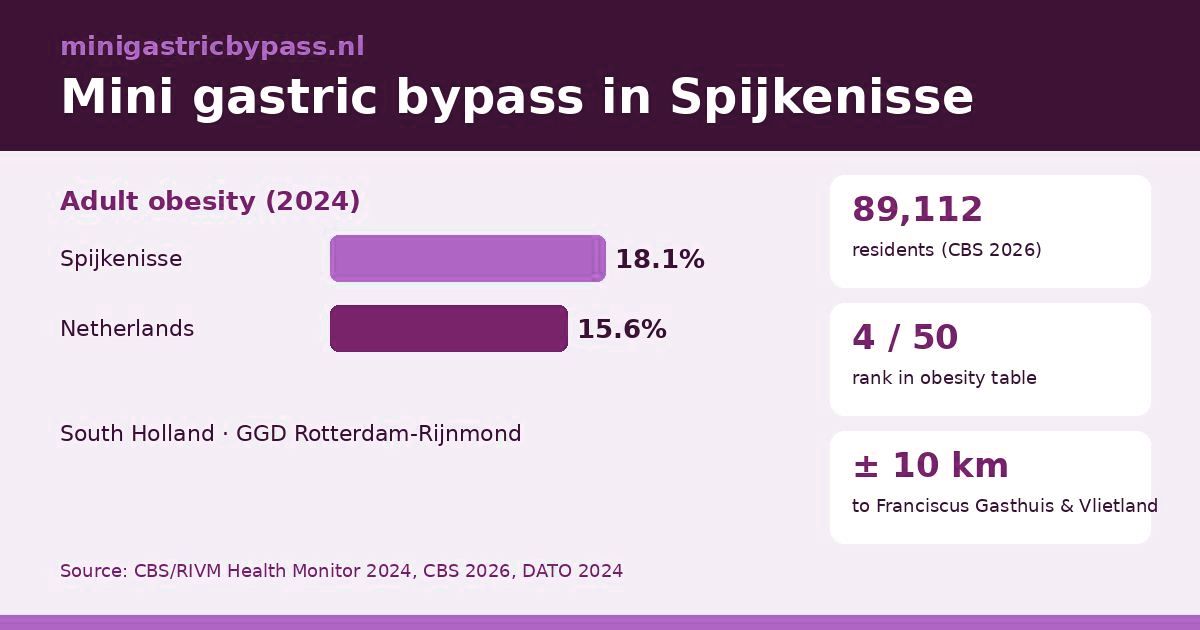
- Of all adults in Spijkenisse, 18.1% live with obesity; among the 50 biggest municipalities that is position 4 / 50.
The mini gastric bypass — also called one anastomosis gastric bypass (OAGB), omega-loop bypass or MGB — turns the stomach into a long, narrow tube joined to the small intestine in a single connection. This page is an independent specialist guide for residents of Spijkenisse, with a source for every figure.
Source: CBS 2026, DATO 2024, Health Monitor 2024
The mini gastric bypass in brief, for residents of Spijkenisse
During this operation the surgeon forms a narrow stomach tube along the lesser curve to which a loop of small bowel is attached in one go. This bypasses the first stretch of small intestine, usually 150 to 200 cm. You will also see the terms OAGB and omega loop.
Obesity in Spijkenisse: what do the figures say?
Among adults in the GGD Rotterdam-Rijnmond region, 18.1% live with obesity, compared with 15.6% for the Netherlands as a whole. The gap with the Netherlands: 2.5 percentage points higher. In our ranking of 50 cities that means position 4 (1 = most obesity). That value also applies to Rotterdam, Hoeksche Waard and Schiedam, within the same health service region.
Another 35.2% are overweight without obesity, against 34.4% nationally. Roughly 18 in every 100 adults therefore have obesity. That says nothing about you personally, but it does show how often GPs in Spijkenisse deal with this topic.
| Indicator (adults) | Spijkenisse | All of NL | Rank of 50 |
|---|---|---|---|
| Activity guideline met | 43.7% | 48.9% | 44 |
| Good perceived health | 70.4% | 74.1% | 45 |
| Obesity in Spijkenisse | 18.1% | 15.6% | 4 |
| Moderate overweight | 35.2% | 34.4% | 20 |
| Sport at least weekly | 53.7% | 57.5% | 41 |
| Smokes | 18.6% | 15.6% | 6 |
South Holland in figures: where does Spijkenisse stand?
South Holland is represented by 12 municipalities, among them Hoeksche Waard and Schiedam. The average of those municipalities is 15.9%, against 18.1% for Spijkenisse. Ranked high to low, Spijkenisse is 1 of 12 in South Holland. With 89,112 residents, Spijkenisse ranks 43 among the largest municipalities.
Spijkenisse compared with Hoeksche Waard, Schiedam and Rotterdam
The nearest large municipalities: Hoeksche Waard (5 km), Schiedam (10 km) and Rotterdam (15 km). All four fall under the same health service and so share the same figure. Also see mini bypass surgery in Hoeksche Waard, the mini bypass for Schiedam and mini bypass surgery in Rotterdam.
| City | Residents | % obesity | Distance |
|---|---|---|---|
| Spijkenisse | 89,112 | 18.1% | - |
| Hoeksche Waard | 91,445 | 18.1% | about 5 km |
| Schiedam | 81,931 | 18.1% | about 10 km |
| Rotterdam | 673,804 | 18.1% | about 15 km |
Question about the mini gastric bypass?
Where does surgery take place from Spijkenisse?
For the procedure you go to a bariatric centre, and every centre reports its outcomes to the national DATO registry. In the Spijkenisse region these are Maasstad Ziekenhuis in Rotterdam (about 15 km) and Franciscus Gasthuis & Vlietland in Rotterdam/Schiedam (about 10 km). Looking at all 19 centres in the DATO annual report, Franciscus Gasthuis & Vlietland in Rotterdam/Schiedam is nearest: about 10 km. The mini bypass is not done everywhere, so do check. You are free to choose a centre yourself. On this site Maasstad Ziekenhuis is also listed for Rotterdam.
| Institution | City | Distance (straight line) |
|---|---|---|
| Maasstad Ziekenhuis | Rotterdam | about 15 km |
| Franciscus Gasthuis & Vlietland | Rotterdam/Schiedam | about 10 km |
Advantages and considerations for residents of Spijkenisse
The guideline recognises the OAGB as one of three standard operations; more detail is available at key considerations for the OAGB.
| Advantage | Why |
|---|---|
| One bowel connection | Because the small bowel is attached in just one place, the set-up stays simpler. |
| What it does for type 2 diabetes | Weight-related diseases get much better; for type 2 diabetes the effect may be even greater than with a Roux-en-Y. |
| Long-term data | Carbajo still saw 70% excess weight loss after 12 years in 1,200 patients. |
| Drawback | Details |
|---|---|
| Youngest technique | The OAGB has not been around as long, so research with 20-year follow-up is hard to find. |
| Gastric stump uncertainty | The theoretical long-term risk of gastric stump cancer is still debated. |
| Existing reflux | Reflux you already have plays a part in deciding; in that case surgeons often favour the classic bypass. |
Paying for a mini bypass from Spijkenisse
Cover applies above a BMI of 40, or between 35 and 40 when a weight-related disease is involved. For type 2 diabetes the National Health Care Institute lowered the threshold to BMI 30 in 2023. Without cover you pay for the pathway yourself. See the price of a mini bypass without an indication.
| When | Your contribution | Note |
|---|---|---|
| You meet the criteria | at most €385 | Only when you have not used up your deductible yet. |
| Travel costs to Maasstad Ziekenhuis | not covered | 15 km or so, measured in a straight line. |
| Supplements | own cost | Necessary for life and seldom paid back. |
Where does the mini gastric bypass come from?
In 1997 the American Robert Rutledge described the first mini gastric bypass. In Spain, Carbajo and Caballero developed a variant with an extra anti-reflux construction, which they named one anastomosis gastric bypass in 2005. In the Netherlands about 10% of bariatric procedures in 2019 were an OAGB, against 59% Roux-en-Y and 24% sleeve. If a leaflet from the South Holland region says OAGB or omega loop, it means the same operation.
Bile reflux: the best-known drawback
In a mini bypass the bowel loop carrying bile sits close to the stomach tube, so bile sometimes travels upwards. The guideline places the reflux risk between that of the classic bypass and that of the sleeve. Medication is enough in most cases. If you already have a lot of heartburn before surgery, discuss it thoroughly at screening.
A mini bypass after a previous sleeve
After a sleeve a second procedure is sometimes needed, mainly for reflux or weight regain; in the literature this reaches up to a quarter of patients. Compared with conversion to Roux-en-Y, conversion to OAGB gave on average 5.7 percentage points extra weight loss (meta-analysis, 2023). If reflux is the reason, a Vienna study suggests the Roux-en-Y is probably the better choice.
More information for people in Spijkenisse
Start with the explanation of the one anastomosis gastric bypass explained. The route from referral to aftercare is in screening before weight loss surgery. Unsure between procedures? See the choice between OAGB and Roux-en-Y. For a comparison with other cities, see the mini gastric bypass by city overview.
The OAGB technique explained for Spijkenisse
The surgeon turns the stomach into a long, narrow tube and joins its end to a single loop of small intestine, roughly one and a half to two metres further along. Food bypasses the first section of the bowel, where much is normally absorbed, and reaches the part that releases fullness hormones sooner.
- keyhole surgery under general anaesthesia, 60 to 90 minutes
- just one anastomosis rather than the two of a Roux-en-Y
- smaller portions and less hunger through changed gut hormones
- with type 2 diabetes, blood sugar often improves within days
OAGB compared with the Roux-en-Y and the sleeve
On paper they look similar; in practice the team chooses based on your situation.
| Feature | Mini gastric bypass | Classic bypass | Gastric sleeve |
|---|---|---|---|
| Bowel connections | 1 | 2 | 0 |
| Operating time | 60–90 min | 90–120 min | 45–75 min |
| Weight loss (total) | 30–40% | 30–40% | 20–30% |
| Internal hernia | <0.12% (WeightWorks) | about 1 to 1.5% | n/a |
| Reflux | bile reflux slightly more common | usually decreases | may increase |
After twenty years, WeightWorks sees no difference in outcome between the mini and the classic bypass. Where they differ is mostly the technique and the side effects, not the weight you end up at.
What is bile reflux and how common is it?
There is only one connection, so bile and pancreatic juice run past the stomach tube along a shared loop. Sometimes bile travels back upwards, giving a bitter taste or a burning sensation. Medicines usually help. If complaints continue, the mini bypass can be turned into a classic Roux-en-Y bypass that moves bile further down the bowel.
So during screening, any reflux you already have is an important point to discuss.
Preparation and screening
Your GP (huisarts) refers you to the bariatric centre. From Spijkenisse you travel to Spijkenisse the options include Maasstad Ziekenhuis in Rotterdam (about 15 km); keep in mind that aftercare runs for at least five years. Then follow an information session, often online, and screening by an internist, psychologist and dietitian, including blood tests. Deficiencies in vitamin B12, D, folic acid or iron are corrected first, and almost every centre requires you to stop smoking.
- explicitly request a bariatric centre referral
- if you can, bring translated records of past weight-loss attempts
- avoid weight changes in the period between information session and operation
- find out whether the OAGB is done at the centre itself, as the techniques on offer differ per centre
Recovery after a mini gastric bypass
The hospital stay is short; most recovery happens at home. Walking is allowed straight away and helps prevent thrombosis; do not lift more than 2.5 kg for the first four to six weeks. Build up exercise after two weeks and strength training after six. Office work is often partly possible after about two weeks.
Your diet goes through stages, from liquid to puréed to solid food in small portions. The set rules are six small meals daily and thirty minutes between eating and drinking.
Vitamins after an OAGB: why extra attention
Once you have had a mini gastric bypass, you need a WLS multivitamin tailored to this operation for the rest of your life, together with at least 1,500 mg of calcium combined with vitamin D each day. After an OAGB your body takes in less fat, so vitamins A, D, E and K (the fat-soluble ones) are monitored extra carefully in your blood. A normal multivitamin bought at the chemist will not do. Anti-inflammatory painkillers are now off the table, including ibuprofen, naproxen and diclofenac. Paracetamol is usually still allowed.
Long-term results
The bulk of the weight comes off in the first half year to year; your weight settles after one and a half to two years. According to Prof. Luc Van Gaal (Antwerp University Hospital), the result lasts well for around a decade. Returning to larger meals and soft drinks frequently means the weight creeps back five to ten years later.
If weight returns or bile reflux persists, the options are a dietitian, supervised medication or revision surgery. Aftercare lasts at least five years; nationally, 1.4 percent of patients had a serious complication in 2024 (DATO Annual Report 2024).
What do you pay yourself?
Do you have an indication and a referral? Then the Dutch basic package covers the mini gastric bypass, and the only cost to you is the €385 deductible. Paying privately, you are looking at about €7,000 to €11,000 for a complete pathway in the Netherlands, and in 2026 WeightWorks asks €10,700 including everything. Insurance never pays for vitamins, so budget €10 to €15 per month. Before you get your referral, find out which centres have a contract with your insurer.
More about the mini gastric bypass from Spijkenisse
When can you work again?
Your type of work makes the difference. If you sit at a desk, you can usually start again after two weeks, building up slowly. Heavy lifting and carrying should wait until week four to six. Begin gentle exercise at two weeks and lift weights from week six. Discuss a gradual return schedule with your company doctor.
What to expect after a year
The bulk of the weight loss has happened once a year has passed. Common reports are better sleep, moving with more ease and using less medication. It does demand continued attention, though. Healthy habits, check-ups and vitamins determine whether you keep the result.
Getting pregnant after a mini gastric bypass
Pregnancy is possible, but not in the first year, when you lose weight fast. Take 400 micrograms of folic acid from four weeks before conception until week ten alongside your WLS multivitamin, and do not switch to ordinary pregnancy vitamins yourself. Always tell your midwife about the operation; blood tests will be more frequent.
Medication as an alternative
A growing number of people put surgery side by side with weight loss medication. Medicines are an option for those with a lower BMI or those who prefer not to be operated on, and they are always combined with lifestyle guidance. With a BMI of 40, or 35 plus a condition, surgery achieves more, and more lasting, results on average.
Popular questions about the mini gastric bypass
FAQ: OAGB for residents of Spijkenisse
How many adults in Spijkenisse have obesity?
In the GGD Rotterdam-Rijnmond region, the obesity rate measured by the public health service is 18.1%, which is position 4 on our list. Nationally the figure is 15.6%.
Where is the quickest option from Spijkenisse?
Nearest is Franciscus Gasthuis & Vlietland in Rotterdam/Schiedam (about 10 km). Ask whether the OAGB is done there; choosing another centre is also fine.
How long will I be in hospital?
Typically a short stay of one to a few nights. The keyhole procedure takes roughly one to one and a half hours.
Are supplements really needed forever?
Yes. Part of the intestine is bypassed, so your blood is tested for shortages at regular intervals.
Is a mini bypass possible after a previous sleeve?
Yes, it is a recognised revision. A 2023 meta-analysis found 5.7 percentage points more weight loss than after conversion to Roux-en-Y; with reflux the Roux-en-Y is often preferred.
Mini gastric bypass or regular bypass: what sets them apart?
With a mini gastric bypass there is a single connection to the bowel, whereas the classic Roux-en-Y needs two. The operation is quicker and leads to much fewer internal hernias, although bile reflux is a little more frequent. You lose about the same amount of weight.
How much weight do you lose after a mini gastric bypass?
On average 30 to 40 percent of your total body weight, most of it in the first year. Weight stabilises after one and a half to two years.
What does bile reflux mean?
Bile flowing back into the stomach tube, causing a bitter taste or burning feeling. Medication usually helps; with persistent symptoms the operation can be converted to a classic bypass.
How long does the operation take?
Under general anaesthesia, the surgeon carries out a mini gastric bypass by keyhole surgery; this normally lasts 60 to 90 minutes.
After a mini gastric bypass, what vitamins should I take?
Daily: a mini bypass WLS multivitamin and a minimum of 1,500 mg calcium combined with vitamin D. In blood work, extra focus goes to A, D, E and K, the vitamins that are fat-soluble.
Is the OAGB a safe procedure?
The operation is done by keyhole (laparoscopic) surgery and carries a relatively low risk. Across the Netherlands, 1.4 percent of patients experienced a serious complication in 2024, according to the DATO Annual Report 2024. WeightWorks reports internal hernias in fewer than 0.12 percent.
Converting a mini gastric bypass: can it be done?
Yes. If bile reflux persists or your weight comes back, the mini bypass can be turned into a classic Roux-en-Y bypass. This is a new operation, with a separate screening.
Where would I have surgery if I live in Spijkenisse?
The nearest centre is Spijkenisse the options include Maasstad Ziekenhuis. You may also choose another DATO-certified centre, as long as your insurer covers it.
What does a mini gastric bypass cost for residents of Spijkenisse?
With an indication and referral only your €385 deductible in 2026. Self-pay, a full pathway costs roughly €7,000 to €11,000.
What do I need for a referral in Spijkenisse?
Ask your GP explicitly for a referral to a bariatric centre and bring evidence of earlier weight-loss attempts.
Is the weight loss lasting?
For about a decade the weight loss holds up well. Beyond that point a gradual regain happens in some people, in most cases due to changes in how they eat.
Is the mini bypass a small operation?
No. The word ‘mini’ is about the one bowel connection, not about how well it works. You lose a similar amount of weight as with the classic bypass.
How long does it take to recover?
On average it takes three to six weeks. You may walk from day one, but avoid lifting more than 2.5 kg during the first four to six weeks.
Can you convert a mini bypass?
Yes. Persistent bile reflux is the main reason to switch to a classic Roux-en-Y. It is a separate new operation, which insurance covers when there is a medical need.
A year later, what do people say?
Many mention more energy, fewer medicines and moving with less effort. They also mention that vitamins, check-ups and habits stay important for good.
Sources
- CBS population register 1 January 2026 via AlleCijfers - municipalities ranked by population
- Statistics Netherlands (CBS), RIVM and municipal health services - Health Monitor Adults and Elderly 2024, table 86137NED
- DICA - Dutch Audit for Treatment of Obesity (DATO), annual reports
- Dutch Society for Surgery (NVvH) - Guideline Surgical treatment of obesity, module Surgical technique in adults (2020)
- National Health Care Institute (Zorginstituut) - Obesity care and reimbursement conditions
- National Health Care Institute (Zorginstituut) - Position on bariatric surgery in type 2 diabetes with BMI 30-35 (10 May 2023)
- StatPearls - One Anastomosis Gastric Bypass and Mini Gastric Bypass (NCBI Bookshelf)
- IFSO - One Anastomosis Gastric Bypass
- Carbajo et al. - OAGB: technique and long-term results in 1,200 patients (Obesity Surgery)
- Revisional surgery after OAGB/MGB: Italian multicentre survey, 8,676 patients (Obesity Surgery)
- Bariatrie Groep Nederland foundation - Mini gastric bypass
- OAGB versus RYGB as revision after sleeve: systematic review and meta-analysis (Langenbeck's Archives of Surgery, 2023)
- Five-year outcomes of OAGB as revision after sleeve for insufficient weight loss (Scientific Reports, 2022)
- Sleeve converted to RYGB and OAGB: results from the Medical University of Vienna (Obesity Surgery)
Question about the mini gastric bypass?